Many churches have hymnals, but perhaps the Methodist Hymnal is unique for including its “Directions for Singing”–a list of 7 principles regarding how to sing during worship services. Before becoming Unitarian Universalists, Susan and Steve were each members of the United Methodist Church for over 20 years, and so we appreciate that both the United Methodist church that we attended and our UU church emphasize active engagement in congregational singing as a vital part of the worship service. In the spirit of drawing from other sources for wisdom, we are sharing the United Methodist Church’s perspective on singing hymns.
John Wesley (1703-1791), a co-founder and the primary organizer of the Methodist movement within the 18th-century Church of England, published the first Anglican hymnal in North America in 1737 and later provided the founding liturgy and hymnody for the independent American Methodist church.
In 1761, Wesley published Select Hymns: with Tunes Annext. This hymnal was a landmark in Methodist history, serving as a primary tool for standardizing congregational worship and defining the movement's musical identity.
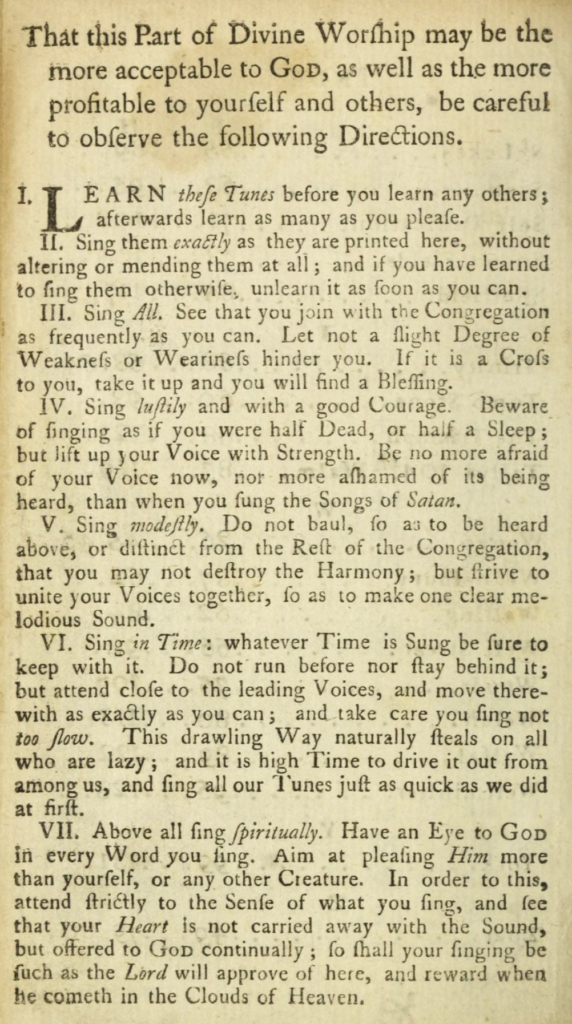
The most enduring part of this 1761 hymnal is the “Directions for Singing” that Wesley included to ensure that singing was a spiritual act of worship that promoted unity and participation by including everyone, and to ensure that singers were focused on God rather than on themselves.
John Wesley’s “Directions for Singing” is still a wonderful set of guidelines for congregational singing 265 years later:
That this Part of Divine Worship may be the more acceptable to God, as well as the
more profitable to yourself and others, be careful to observe the following Directions.
- I. Learn these Tunes before you learn any others; afterwards learn as many as you please.
- II. Sing them exactly as they are printed here, without altering or mending them at all; and if you have learned to sing them otherwise, unlearn it as soon as you can.
- III. Sing All. See that you join with the Congregation as frequently as you can. Let not a slight Degree of Weakness or Weariness hinder you. If it is a Cross to you, take it up and you will find it a Blessing.
- IV. Sing lustily and with a good Courage. Beware of singing as if you were half Dead, or half a Sleep; but lift up your Voice with Strength. Be no more afraid of your Voice now, nor more ashamed of its being heard, than when you sung the Songs of Satan.
- V. Sing modestly. Do not bawl, so as to be heard above or distinct from the Rest of the Congregation, that you may not destroy the Harmony; but strive to unite your Voices together, so as to make one clear melodious Sound.
- VI. Sing in Time: whatever Time is Sung, be sure to keep with it. Do not run before nor stay behind it; but attend close to the leading Voices, and move therewith as exactly as you can; and take care you sing not too slow. This drawling Way naturally steals on all who are lazy; and it is high Time to drive it out from among us, and sing all our Tunes just as quick as we did at first.
- VII. Above all sing spiritually. Have an Eye to God in every Word you sing. Aim at pleasing Him more than yourself, or any other Creature. In order to this, attend strictly to the Sense of what you sing, and see that your Heart is not carried away with the Sound, but offered to God continually; so shall your singing be such as the Lord will approve of here, and reward when he cometh in the Clouds of Heaven.
The first two directions–I and II–need a little context to better appreciate why they were included. Wesley wanted to ensure that each local society of the new Methodist movement conformed to standard Methodist practices in its worship. Wesley believed that the congregation members learned their theology from the hymns they sang, and so he was protective of the specific lyrics and the melodies in this hymnal.
However, the remaining 5 directions are still very appropriate guidelines for all of us to keep in mind when we are singing our congregational songs.
So, the next time you are invited to join in singing a congregational song, “sing lustily and with a good courage”, “sing modestly”, “sing in time”, and “above all sing spiritually”!

Susan Shaw and Steve Morihiro, both longtime choir members, are the Co-Directors of Music Ministries.